
CoinGecko is one of the world's largest cryptocurrency data platforms, serving over 400 million monthly visitors. If you want to understand how to get listed on CoinGecko, you need to know that unlike paid listing services, CoinGecko offers completely free listings but maintains strict quality standards for project approval.
Getting your token listed on CoinGecko provides immediate credibility and exposure to millions of crypto enthusiasts, traders, and institutional investors. The platform's comprehensive project profiles, Trust Score algorithm, and integration with numerous portfolio apps make it essential infrastructure for any serious cryptocurrency project.
CoinGecko's Core Listing Requirements
Before exploring how to get listed on CoinGecko, understand their fundamental prerequisites. Your cryptocurrency must be actively trading on at least one exchange that CoinGecko already tracks. This requirement is non-negotiable – the platform exclusively lists assets with verifiable market activity.
CoinGecko tracks hundreds of exchanges, from major centralized platforms like Binance and Kraken to decentralized exchanges like Uniswap and PancakeSwap. Your token must have genuine trading activity, not artificial volume or wash trading, which their systems easily detect.
You need a functional website containing comprehensive information about your cryptocurrency project. Incomplete websites, placeholder pages, or sites lacking essential project details result in automatic rejection. Your website serves as the primary information source for CoinGecko's evaluation team.
Professional documentation is mandatory. Your whitepaper should clearly explain your project's purpose, technology, tokenomics, team information, and roadmap. Marketing materials don't substitute for technical documentation – CoinGecko's reviewers are experienced professionals who evaluate substance over hype.
Preparing Your Application Materials
Successful completion of how to get listed on CoinGecko starts with thorough preparation. Create a comprehensive checklist including token name, symbol, blockchain network, smart contract address, total supply, circulating supply, and official website URL.
Gather all exchange information where your token trades. For each exchange, document the specific trading pairs, direct links to trading pages, and current trading volumes. Include both centralized and decentralized exchanges to demonstrate broad market acceptance.
Compile your social media presence documentation. CoinGecko requires links to official accounts across platforms like Twitter, Telegram, Discord, and Reddit. Ensure these accounts are active, professionally managed, and regularly updated with meaningful project content.
Prepare team and company information including key team member profiles, their professional backgrounds, and roles within the project. While anonymous teams aren't automatically disqualified, transparent team information significantly improves approval chances.
Step-by-Step Application Form Completion
Access CoinGecko's self-service request form through their official support portal. The form is divided into several sections requiring specific information and careful attention to detail.
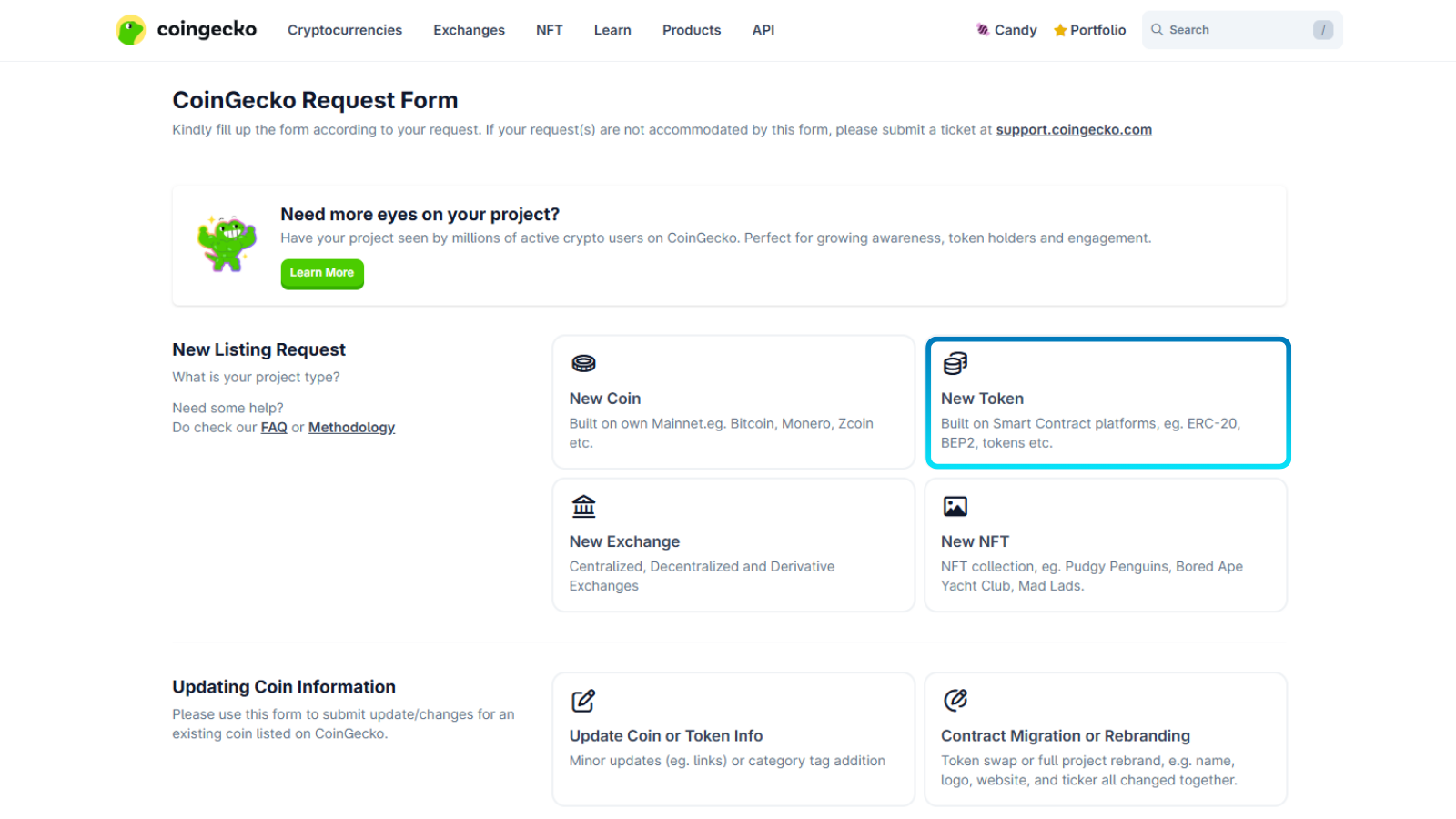
First selection
At the very beginning, you need to select what the listing request concerns. For the purposes of this guide, we select the “New Token” option.
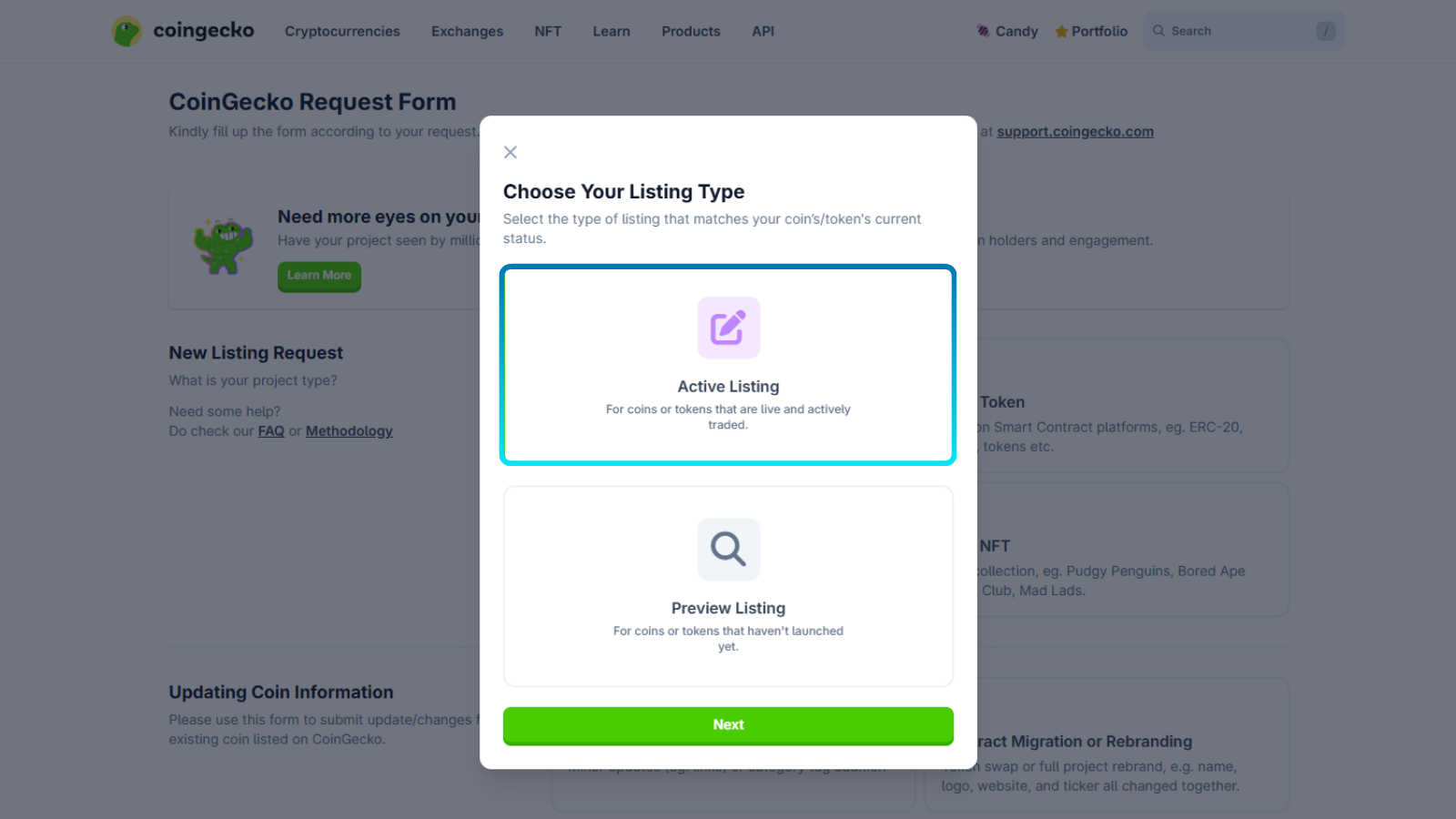
The next important step is to decide whether your token is already active or whether you are still before launch. If your token has not yet been created, you can easily create it in our crypto token generator. Since we are considering the form in terms of an existing token, we select the “Active Listing” option.
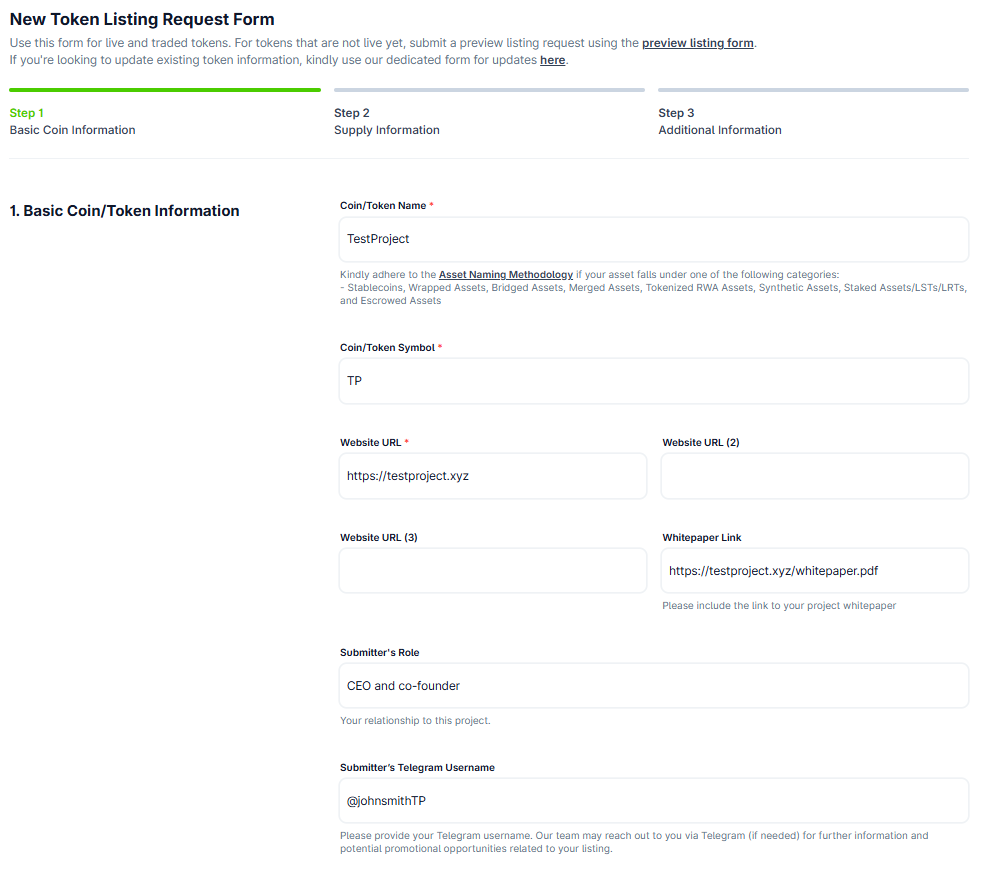
Basic Coin Information
This initial section establishes your project's identity. You'll need to provide the official token name and symbol, which should align with your branding. Enter your primary website URL, with additional fields available for secondary sites. Include your whitepaper link to demonstrate the project's foundations, specify your role within the organization, and provide your Telegram username for direct communication with the listing team.
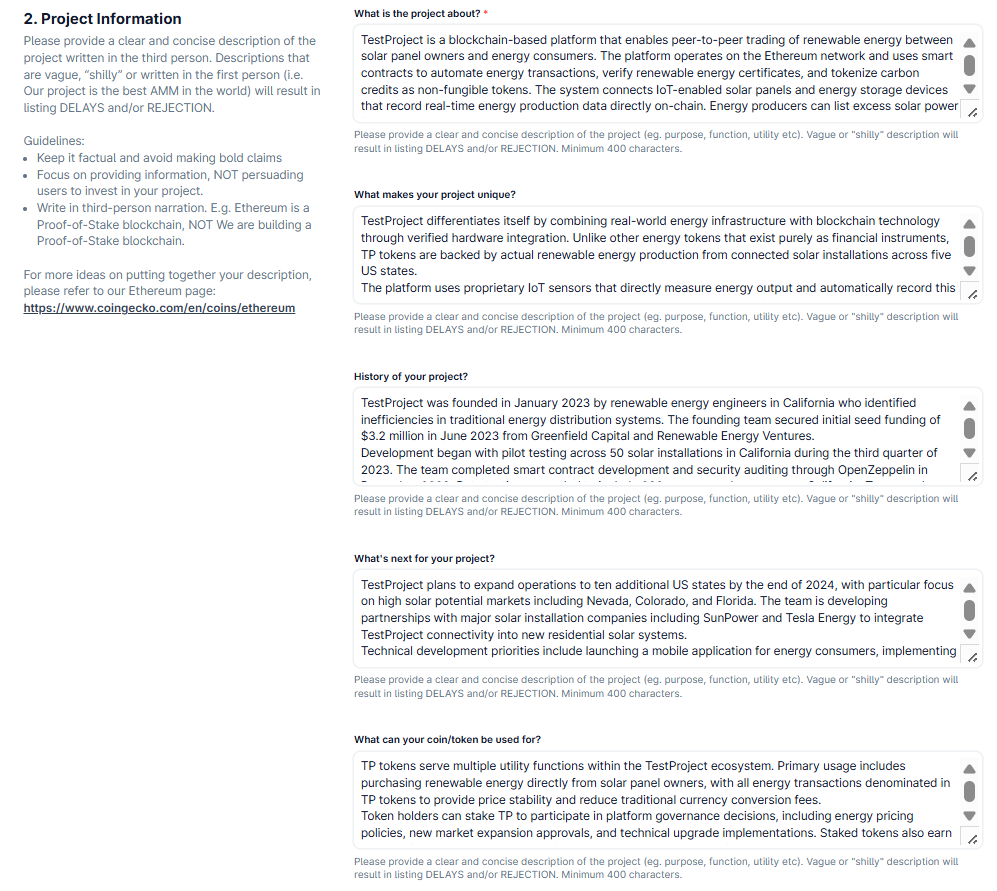
This section requires comprehensive narrative descriptions of your project. Write a detailed explanation of what your project does and its value proposition. Clearly describe what differentiates your project from competitors, highlighting innovative features or novel approaches. Showcase your development timeline including founding dates, milestones, and partnerships. Explain your future roadmap with technical developments and market expansion plans. Finally, explain how your token functions within the ecosystem, whether for transactions, governance, staking, or other utilities.
This section focuses on where and how your token can currently be traded. You'll provide direct links to decentralized exchanges like Uniswap where users can swap your token, ensuring these links are functional and lead to the correct trading pairs. The URLs should be complete and properly formatted to avoid any confusion for potential traders or investors who want to access your token immediately.
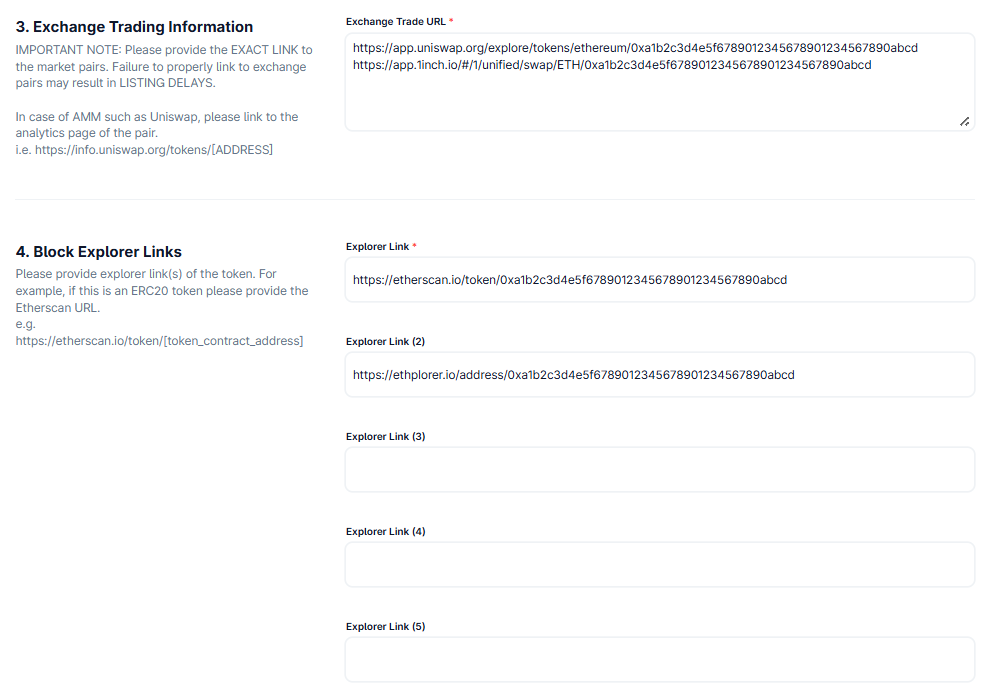
This technical section requires you to specify the blockchain platform your token operates on. The token contract address is the unique identifier for your token on the blockchain and must be entered precisely to avoid any errors. You'll also need to specify the number of decimal places your token uses, which affects how fractional amounts are displayed and handled across different platforms and wallets.
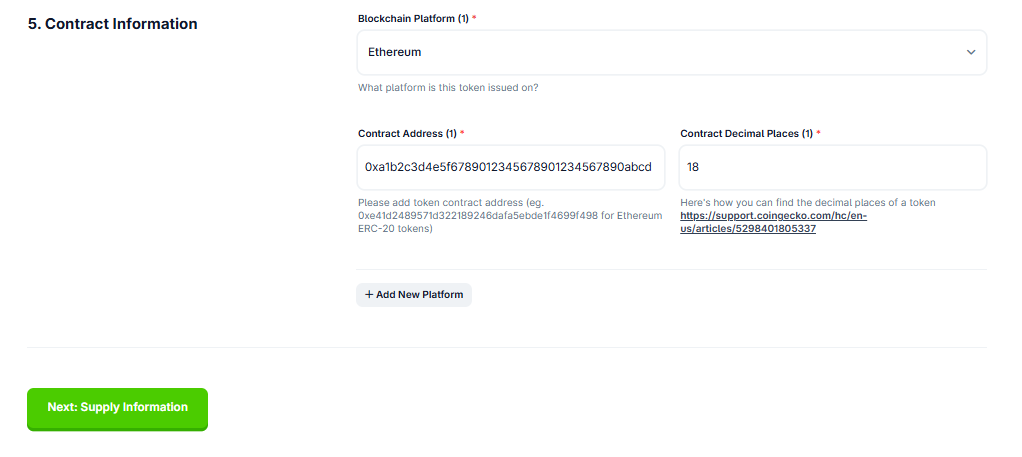
Supply Information
This section covers your project's tokenomics in detail. You'll provide links to holder distribution information showing top token holders, along with documentation explaining how tokens are allocated among stakeholders. Set your Token Generation Event date and specify the maximum supply (or indicate if infinite).
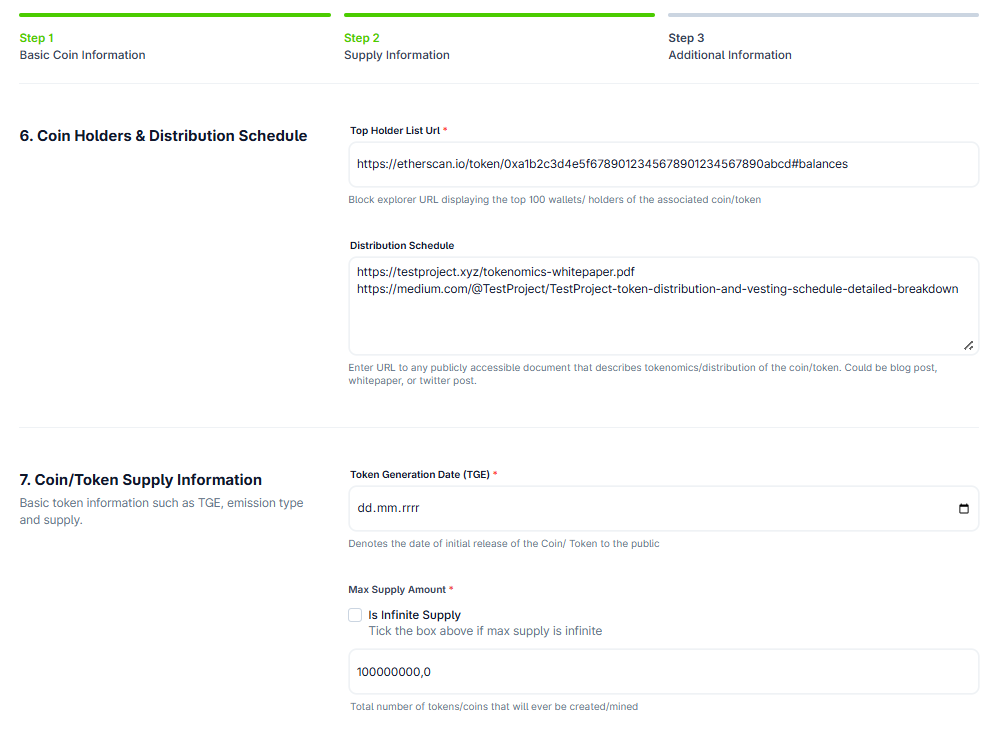
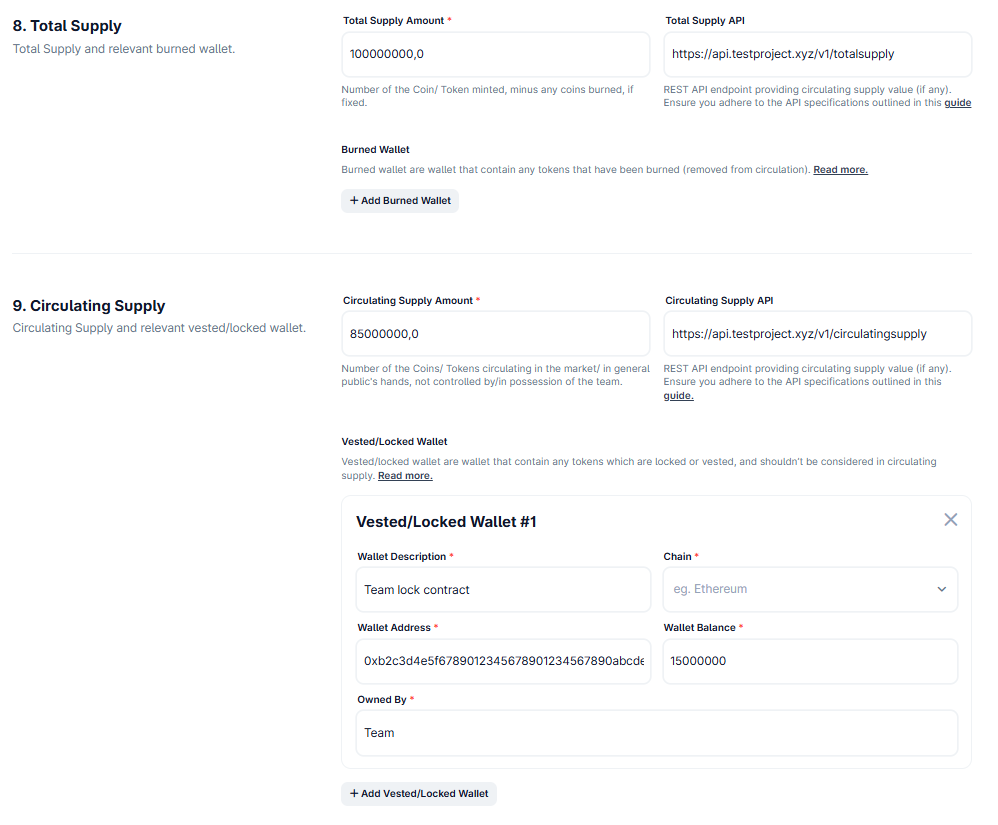
This section requires you to provide detailed tokenomics data that demonstrates transparency about your token's supply mechanics. You'll need to specify your total token supply figures and differentiate between total and circulating amounts. Optionally, you can provide API endpoints that allow real-time verification of these numbers.
Identify any burned token addresses where tokens have been permanently removed from circulation. Also, define locked or vested wallet categories that temporarily restrict token availability. For each locked wallet, you must provide clear descriptions of their purpose, exact addresses, token balances, and ownership details to help users understand which tokens are currently restricted from market circulation and why.
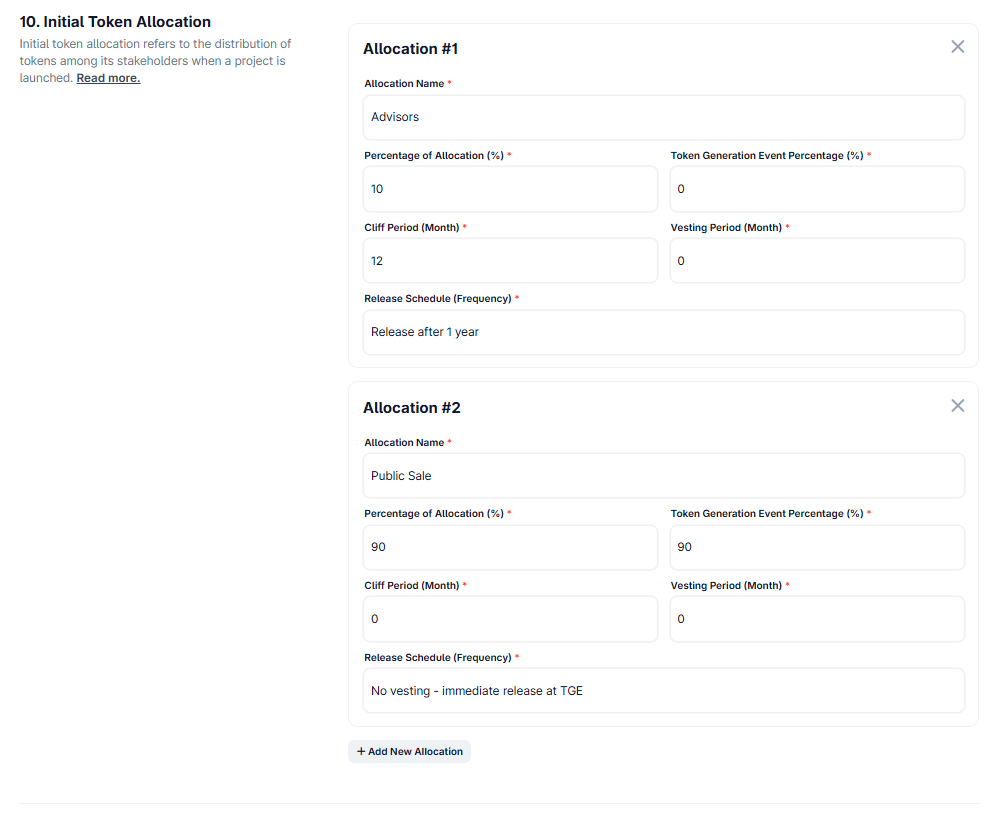
This is the section where you detail how tokens were initially distributed among different stakeholder groups. Each allocation requires a descriptive name (like "Advisors" or "Public Sale"), the percentage of total supply allocated, any cliff periods before tokens become available, vesting periods over which tokens are released, and the frequency of token releases. This information is critical for investors and users to understand the token release schedule and potential market impact of large token unlocks.
Additional Information
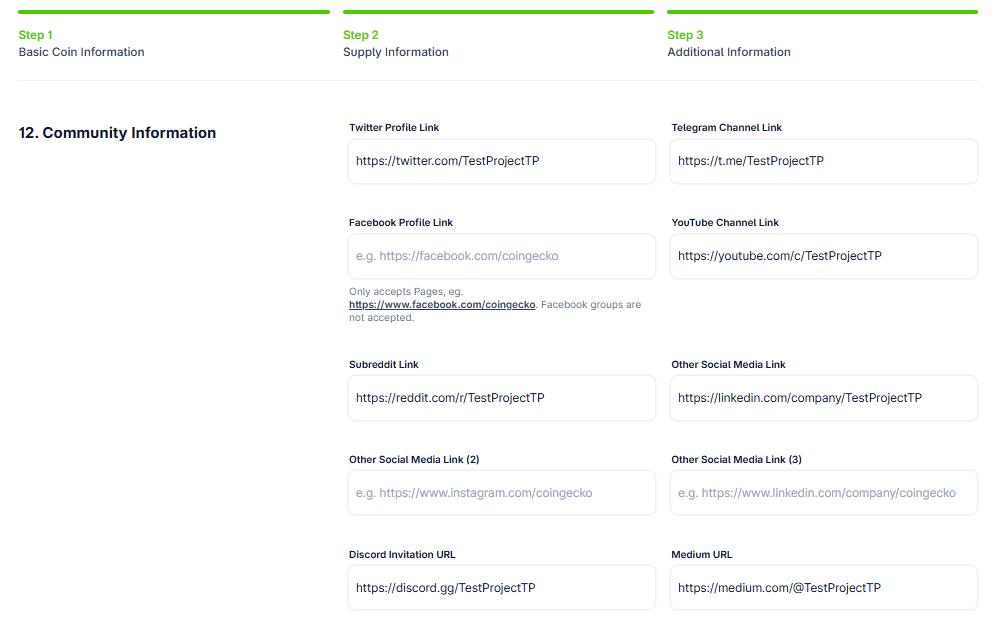
This section builds your project's social media presence within the listing. You'll provide links to official social media accounts across various platforms including Twitter, Telegram, Facebook, YouTube, Reddit, LinkedIn, Discord, and Medium. Each link should lead to official, verified accounts that actively represent your project and provide ongoing updates to the community.
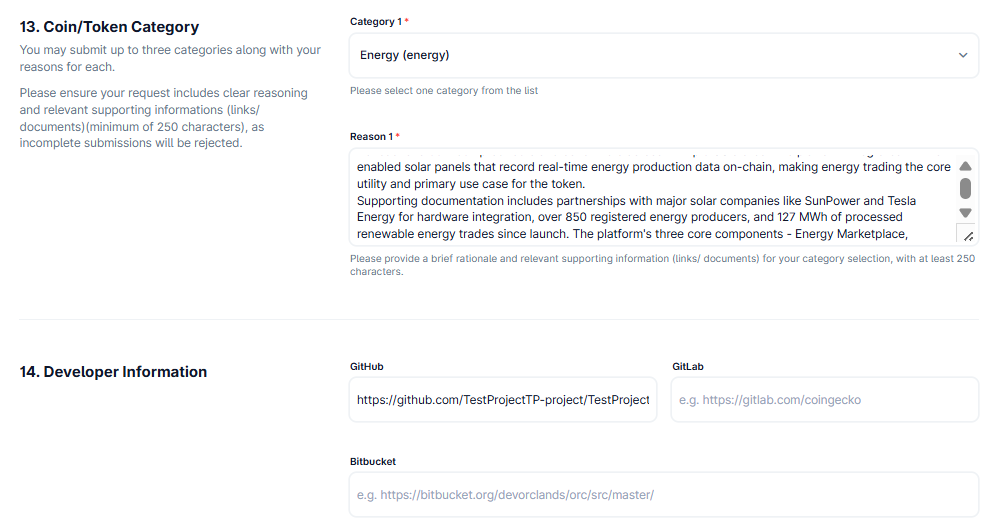
You'll select the most appropriate category for your token from a predefined list, such as DeFi, Gaming, Infrastructure, or others, and provide a detailed explanation of why this category fits your project. The developer information section requires links to your technical repositories, typically GitHub, GitLab, or Bitbucket, where the code behind your project can be reviewed and verified by technical users and auditors.
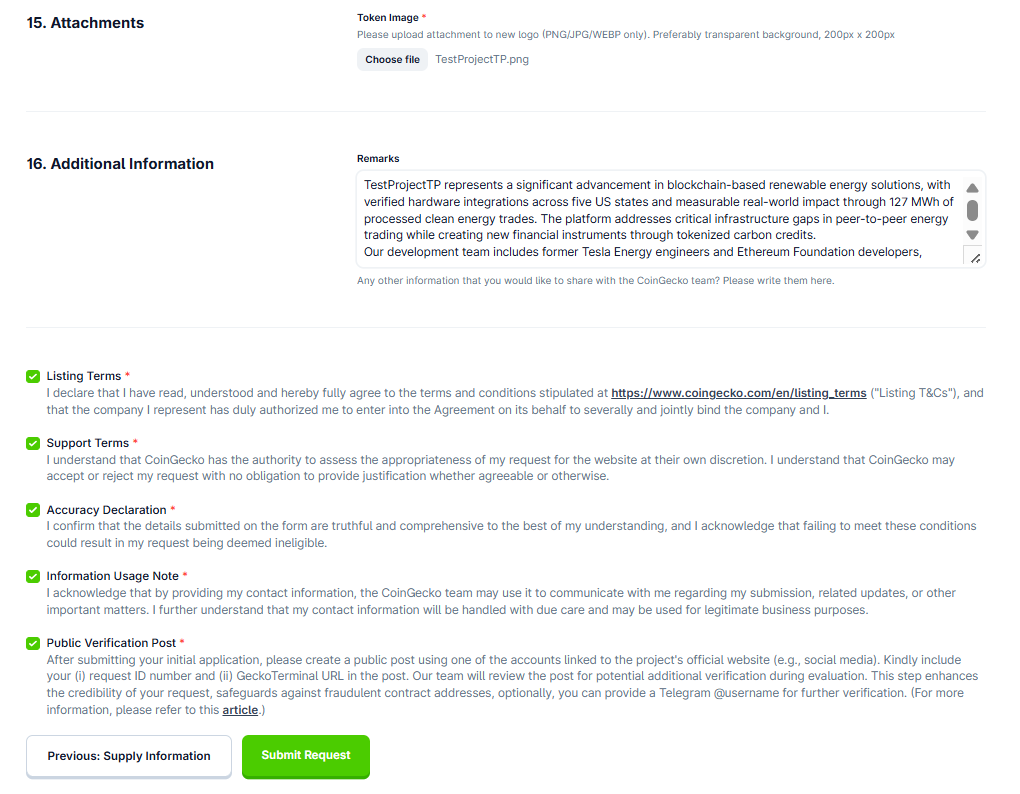
Complete the application by uploading your token logo in PNG format. Add any supplementary information in the remarks section that doesn't fit elsewhere but might be relevant for review. Finally, agree to all required terms including listing conditions, support terms, accuracy declarations, information usage permissions, and public verification requirements before submitting your application.
Essential Success Guidelines
The most common mistakes sabotaging applications are incomplete information – missing social media links, broken website sections, or unclear token specifications. Technical errors like wrong contract addresses, mismatched token supplies, or incorrect exchange information signal lack of professionalism and often result in immediate rejection requiring complete reapplication.
Community pressure campaigns backfire spectacularly. Encouraging supporters to contact CoinGecko asking "when listing?" irritates reviewers and can result in application rejection. Also avoid poor timing – applying immediately after token launch, during obvious price manipulation periods, or while major technical issues remain unresolved demonstrates poor judgment.
Understanding how to get listed on CoinGecko includes managing expectations during the review process. Evaluation timelines vary from weeks to months depending on application volume and project complexity. Respond quickly and comprehensively when CoinGecko requests additional information, but don't submit multiple applications or repeatedly contact them for status updates.
After listing approval, ongoing responsibilities remain crucial. Keep your project information current using CoinGecko's update tools and monitor your listing for data accuracy, reporting discrepancies promptly. CoinGecko reserves the right to delist projects that no longer meet their standards, so continue building legitimate trading activity and focus on sustainable community development for long-term success.
Final Recommendations
Learning how to get listed on CoinGecko successfully requires more than completing an application form – it demands building a project worthy of the platform's standards. Focus on creating genuine utility, building authentic community engagement, and maintaining complete transparency throughout your development process.
The application process serves as a quality filter that benefits the entire cryptocurrency ecosystem. Projects that prioritize substance over speculation, community engagement over marketing gimmicks, and long-term vision over short-term gains are most likely to achieve successful listing and maintain their status.
Approach your CoinGecko application strategically but authentically. Every aspect of your project – from technical development to community building to market presence – influences your success. Build something valuable for the crypto community, and the listing will follow naturally.


